How we turned feature development into a repeatable, orchestrated pipeline — with quality gates a traditional team would envy.
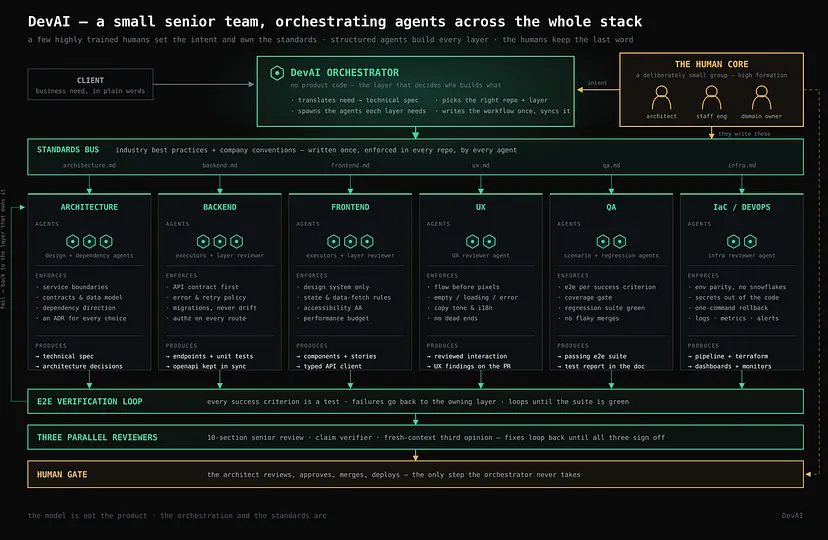
The orchestration layer: a few senior humans, agents on every layer
Picture how a mid-sized feature ships in a traditional software team. A product owner writes a ticket. A backend developer picks it up, then waits on the frontend developer, who waits on the UX designer, who is in a meeting. QA gets the build on Thursday. Someone forgets to update the docs. Two weeks — often more — of handoffs, dailies, and context evaporating every time the work changes hands.
Now picture the same feature shipping in a couple of hours: with a written requirements document, an isolated environment, parallel implementation agents, end-to-end tests that loop until they pass, updated documentation, a tracking card that closes itself, and a pull request reviewed by three independent reviewers — before a human ever looks at it.
That second picture is how we work today. And the key was never “using AI.” AI without structure is just a very fast junior developer. The key is three things working together: structured workflows, parallelization, and agent orchestration.
What a workflow is (and why it beats prompting)
In our repositories, a workflow is not a diagram on a wiki. It is an executable, versioned recipe that lives inside the repo itself — a skill that orchestrates other skills and agents, from the first environment check to the final pull request.
That single decision — making the process code instead of tribal knowledge — pays out four ways:
- Repeatability. Every feature travels the same road, through the same quality gates. There is no “we skipped tests because we were in a hurry.”
- Persistent knowledge. Each run leaves artifacts behind: a requirements document, a development history, discovered insights. The next run starts smarter than the last.
- Quality that is structural, not optional. Testing, documentation, and code review are not habits that depend on someone’s discipline on a given day. They are wired into the pipeline.
- Instant onboarding. “How we work here” is a file you can read — and an agent can execute — not oral tradition.
We maintain a small family of these workflows: one for feature development (the star of this post), one for systematic troubleshooting, one for design & discovery (turning a client meeting into an implementation-ready backlog), one for pull-request review, and even ones for team onboarding and offboarding. Each deserves its own article; today we walk through the first.
Anatomy of the feature workflow
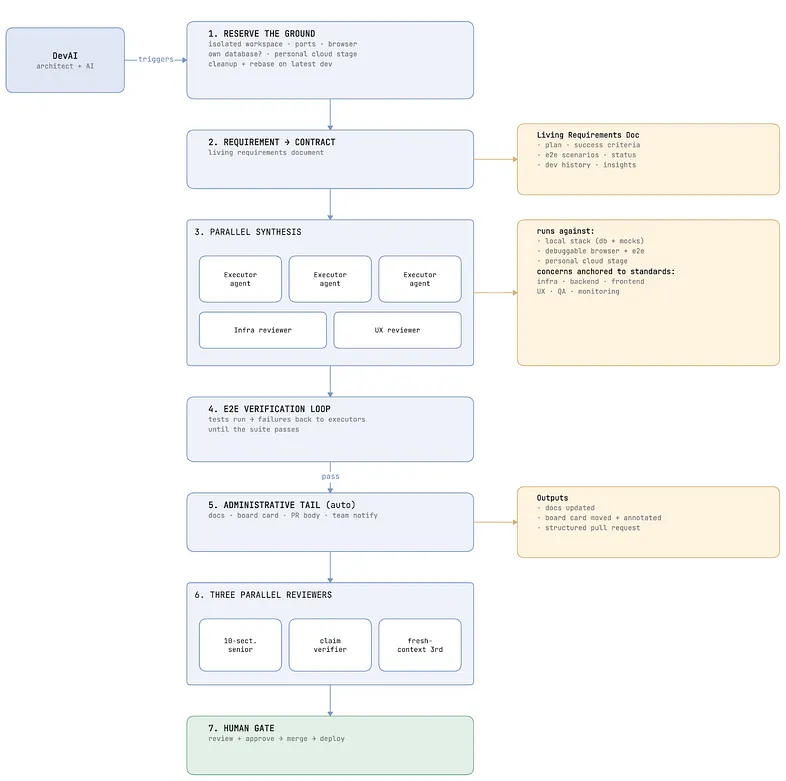
The feature workflow — the only manual gate is the last one.
Here is what actually happens when we say “build this feature.”
-
The workflow reserves its own ground. Before a single line is written, the pipeline prepares an isolated workspace: its own working copy of the code, its own ports, its own browser for testing, and — when needed — its own database and its own personal cloud stage. It cleans up leftovers and rebases on the latest development branch. This sounds like housekeeping. It is actually the foundation of everything in the final section of this post: if a workflow owns its resources, nothing stops you from running several of them at once.
-
The requirement becomes a contract. The workflow generates a living requirements document: the plan, the success criteria, the end-to-end test scenarios, a status lifecycle, and — as work progresses — a development history and a log of discovered insights. This is not paperwork produced after the fact. It is the contract the implementation agents execute against, and the memory the project accumulates.
-
Synthesis happens in parallel. This is where the model breaks with tradition most visibly. Implementation is not one agent typing sequentially — it is several executor agents building in parallel, while specialist review agents (infrastructure review, UX review) inspect the work as it takes shape. Every concern a traditional team would assign to a different person — infrastructure, backend, frontend, UX, QA, monitoring — is represented by an agent, and each is anchored to explicit standards: industry frameworks (think cloud well-architected guidelines) plus the company’s own conventions. The work runs against a real environment: a local stack with database and mocks, a debuggable browser with automated end-to-end tooling, and a personal cloud stage.
-
Verification is a loop, not a phase. End-to-end tests run, and failures go back to the executor agents — automatically — until the suite passes. Nobody schedules a “QA round.” The loop belongs to the workflow, not to a calendar.
-
The administrative tail closes itself. The part of shipping that teams most often skip is exactly the part agents never skip: documentation gets updated, the tracking card on the project board is moved and annotated through an integration, the pull request is created with a structured description, and the team channel is notified when appropriate.
-
Three reviewers, always. Every pull request — including one-line fixes — is reviewed by three independent agents in parallel: a senior-style reviewer that works through a ten-section checklist, a verifier that independently re-checks every claim the pull request makes (“tests pass” is verified, not trusted), and a third reviewer dispatched with completely fresh context, precisely so it doesn’t inherit the author’s blind spots. Three genuinely independent opinions, on every change, every time. Few human teams can honestly claim that.
-
The human sits where humans matter. The only manual gate in the entire pipeline is the final one: a person reviews the pull request and approves the merge that triggers deployment. The human doesn’t type — the human decides.
One layer up: the Workspace AI
A feature workflow governs one repository. But a real product is never one repository. A typical client ecosystem looks something like this:
client-web-app— the customer-facing web applicationclient-sync-service— the integration and data-synchronization serviceclient-browser-extension— a browser tool for the operations teamclient-automations— low-code workflow automations gluing services together
Above them all sits one more repository — the Workspace AI — and it holds no product code at all. It is the ecosystem’s brain:
- It is the central gate for business needs: a client conversation enters, and it comes out translated into technical definitions that follow industry standards plus the company’s own standards.
- It knows how the projects relate and chooses the right home for each new requirement — is this an automation, a service change, a browser-tool feature, or a new application?
- It distributes the practices: workflows and skills are written once, in the workspace, and synchronized to every child repository. An improvement made for one project instantly upgrades all of them.
- It produces the starting artifacts for every effort: the design, the tracking card, the requirements document, and eventually the pull request.
The shortest way we’ve found to say it: the repositories execute; the workspace thinks.
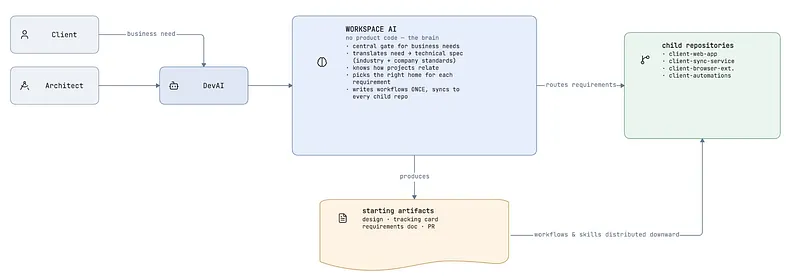
The Workspace AI
The repositories execute; the workspace thinks.
The DevAI: one architect, a whole team’s output
So what does all this machinery add up to, in terms a CFO would recognize?
A traditional mid-sized feature consumes a team — backend, frontend, UX, QA, DevOps — for one to two weeks, much of it lost to handoffs and context switching. The orchestrated workflow delivers the same feature in a couple of hours, with more quality gates, not fewer.
We call the operating model behind this the DevAI: a senior architect directing an orchestra of specialized agents. It doesn’t replace the team with a tool. It condenses the team’s roles into agents — and keeps the judgment, the taste, and the accountability in the hands of an experienced human.
And here is the multiplier we’re most excited about. Remember that every workflow reserves its own isolated resources? That means workflows don’t queue — they run side by side. One DevAI can orchestrate three or four feature workflows simultaneously, each in its own workspace, each with its own agents, tests, and review pipeline. One senior architect, the throughput of several teams.
The efficiency never came from typing code faster. It came from structuring the work so that agents can execute it in parallel, with quality that is verified rather than assumed.
This is the first article in a series. Coming next: running parallel workspaces under a single DevAI; the design & discovery workflow that turns client meetings into implementation-ready backlogs; why three independent review agents beat one human reviewer; and how a living requirements document becomes a project’s long-term memory.
If you’d like to see this pipeline applied to your product — let’s talk.