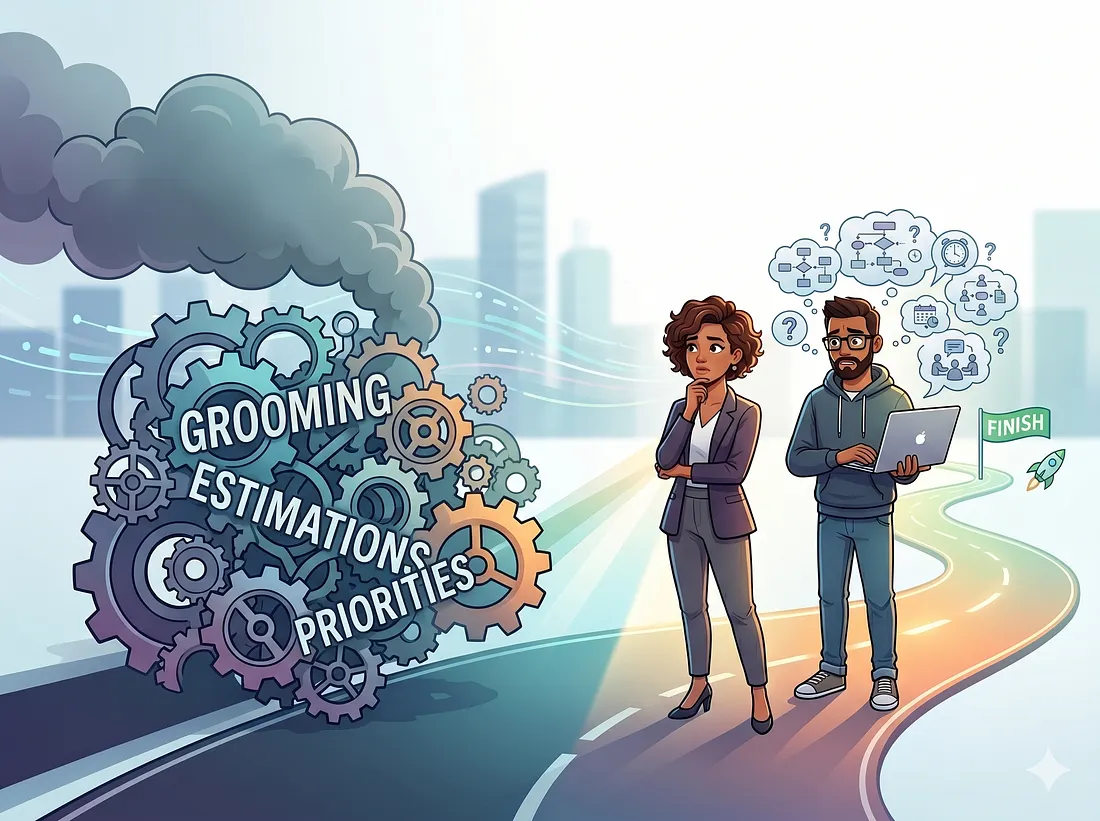
A few months ago, something came up during one of my regular syncs with the team.
One of the senior developers assigned to a client mentioned that a good part of his time was going into grooming sessions, estimations, and conversations about upcoming work. On paper, nothing looked especially wrong. There were meetings. There were priorities being discussed. People were involved.
When I checked in with the client, I heard a different side of the same story. They had a lot they wanted to move on. They were investing time in planning, trying to define priorities, and expecting that process to create alignment.
So this was not a case of people being disengaged. Everyone was spending time on the work. The issue was that too much of that time was happening around the work, before anything was ready to be executed.
The question was: how much time are we spending creating clarity, and how much time are we spending building?
A grooming session can look like alignment. A detailed estimation can look like having things under control. A long conversation about priorities can look like progress. But sometimes those conversations can just create more questions.
It is easy to look at hours, output, and availability as the main indicators. They matter, of course, but they do not tell the full story. A developer can be engaged, proactive, and technically strong, and still lose momentum if too much of their time goes into conversations that do not end in decisions.
So I brought the concern to the client from that angle. Is the team’s time being used in the best possible way?
We talked about the amount of back-and-forth around grooming and estimations, how often some items were being revisited, and where clearer next steps could help. The point was not to remove planning from the process. Planning matters. Estimation matters. Alignment matters. But they only help when they move the team closer to execution.
From there, we aligned on a few practical improvements.
- Grooming conversations needed to end with clearer decisions
- Priorities had to be better defined before asking the developer to estimate or analyze them in depth
- When something was still too vague, it was better to call that out directly instead of turning it into another round of discussion
Sometimes a team member does not need more pressure. They need a clearer path. Sometimes the client does not need to hear “we need more tasks.” They need help seeing where the process itself is creating friction.
For Account Managers, this is an important signal to watch, given that we are often in a useful position to connect what the team is experiencing with what the client is trying to achieve.
If your team is running into similar situations, where there is activity, meetings, and effort, but not enough movement, it may be worth taking a closer look at the process around the work. At White Prompt, we help clients not only find strong technical talent, but also keep the collaboration healthy, clear, and moving forward. Feel free to reach out if you’d like to connect.