Why cutting meetings rarely fixes the coordination problem underneath them

“We have too many meetings.”
It is one of those workplace complaints almost everyone can agree with. So teams start deleting them. The weekly status call becomes a Slack update. The one-hour sync becomes thirty minutes. Wednesday becomes a no-meeting day. A few recurring invites disappear, calendars open up, and for a while it feels like the problem has been solved.
Then the meetings start coming back.
Someone creates a project sync because people are missing updates. A “quick call” appears because the Slack thread has become impossible to follow. Another recurring meeting gets added because two teams keep discovering dependencies too late. A few months later, the calendar looks strangely familiar.
If almost everyone agrees that unnecessary meetings are bad, why are organizations so good at recreating them?
Maybe the meeting was never the whole problem.
We keep treating meetings as units of time
The usual argument against meetings is simple: a one-hour meeting costs one hour. Remove it, and you get the hour back.
That logic is not wrong. It is just incomplete.
There is research suggesting that protecting some time from meetings can improve how people experience their work. One study involving 76 large companies examined organizations that introduced meeting-free days. Employees reported better autonomy, satisfaction, stress levels, and perceived productivity as some meeting-free time was introduced.
There are two details worth keeping in view, though. Productivity in that research was self-reported rather than measured through something like code shipped, sales closed, or another objective output measure. The reported benefits also did not keep increasing indefinitely as more synchronous interaction disappeared.
That makes the finding more useful than a simple “meetings are bad” conclusion. Reducing meetings can help, but the relationship is not linear, and zero meetings is not the obvious destination.
The harder question comes after you delete one: what happens to the work that used to happen inside it?
Sometimes the answer is obvious. A fifteen-minute round of status updates becomes a written update that everyone reads when convenient. Great. That probably did not need six calendars.
Other times, the meeting disappears but the work does not. Now the conversation happens across Slack. Five people reply at different times. Someone misses part of the thread. A decision gets made but never written down clearly. The next morning, somebody sends the message we all know: “Can we just jump on a quick call?”
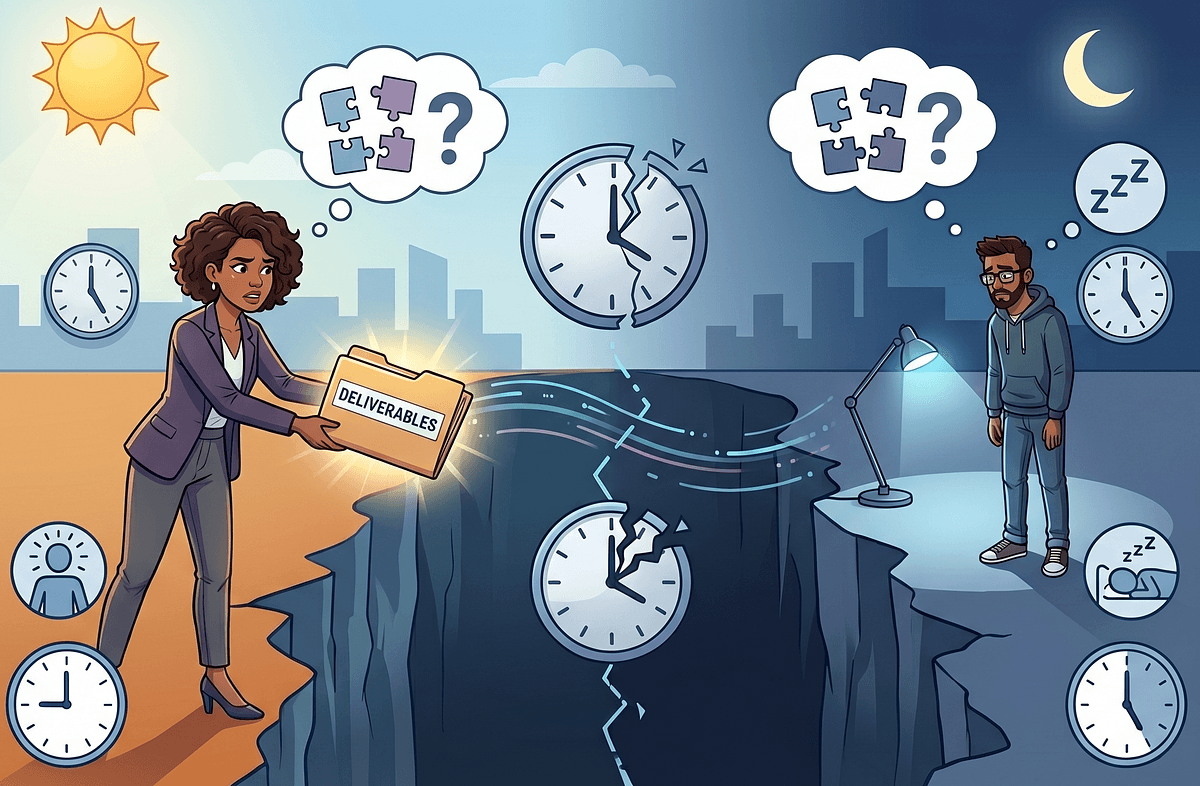
The calendar got better. The coordination problem stayed exactly where it was.
Sometimes we are just using the wrong channel
Not every communication problem needs the same tool.
Take a simple project update: what shipped, what is blocked, and what happens next. If the job is mostly transferring information, gathering everyone at the same moment may be an expensive way to do it. A written update has some obvious advantages. People can read it when convenient, refer back to it later, and share it with someone who was not there.
Now change the situation. A release is at risk. Engineering thinks a known issue is manageable. Product is worried about a customer commitment. Nobody agrees on how serious the trade-off is.
You could handle that asynchronously. You could also spend the next four hours watching a Slack thread grow while everyone responds to a slightly different version of the problem.
Research on communication channels offers a useful way to think about this distinction. Some tasks are mostly about conveying information. Others require people to reach a shared interpretation of what that information means. That second category tends to benefit more from back-and-forth, clarification, and immediate reaction.
This does not give us a clean rule where status updates belong in Slack and difficult decisions belong in Zoom. Real work is messier than that. A status meeting can unexpectedly expose a blocker nobody realized was important, while a difficult decision can sometimes be settled perfectly well in a document.
The useful change is in the question. Instead of asking only whether a meeting can be removed, ask what kind of communication problem the team is trying to solve.
That is a much better place to start.
A meeting does not only consume time
There is another reason a calendar full of meetings can feel worse than the total hours suggest.
Imagine two thirty-minute meetings. One sits between several other calls. The other lands right in the middle of the three-hour block you planned to use for debugging something complicated.
They occupy the same amount of calendar space, but they may not have the same effect on the day.
You may have seen claims that every interruption requires a precise amount of time to “recover focus,” or that context switching destroys some fixed percentage of productivity.
The safer conclusion is also the more useful one: breaking an hour of work into pieces is not always equivalent to having an uninterrupted hour. For someone doing concentration-heavy work, where a meeting sits may matter almost as much as how long it lasts.
This is why two calendars with the same number of meeting hours can feel completely different. One may leave usable blocks of time between conversations. The other may turn the day into a sequence of fragments.
Async isn’t free either
Once meetings are framed as expensive, asynchronous work can start to look like the obvious alternative.
What it is important, is remembering that writing takes time. Good documentation takes even more. Questions sit unanswered, and a ten-minute conversation can become a six-hour exchange because two people happen to check messages at different moments.
Anyone who has worked in Slack long enough also knows that text does not automatically create clarity. Threads grow sideways. Context disappears above the fold. Someone joins late and answers an old message. Two people eventually discover they have been using the same word to mean different things.
Then somebody asks for the quick call.
That does not necessarily mean the async process failed. It may simply mean the problem changed. Async might have been perfectly suited to distributing the information, but poorly suited to resolving the disagreement that followed.
This is why “this meeting could have been an email” is only half a useful joke. Sometimes the more interesting question is how many emails it would take before a twenty-minute conversation becomes the cheaper option.
And “cheaper” does not only mean minutes. It includes waiting for replies, writing effort, interruptions, ambiguity, emotional nuance, and the cost of losing context later.
For some problems, the best answer may involve both modes. Read the material first. Discuss the ambiguous part together. Write down the decision afterward. There is no requirement that one channel has to win.
Your calendar might be trying to tell you something
Recurring meetings become more interesting when you stop seeing them only as calendar events and start treating them as clues.
A weekly status meeting might exist because the team genuinely needs rapid coordination. It might also exist because nobody has a reliable way to see what is happening without asking everyone out loud.
A handoff call may be necessary because the work is complex, or it may exist because important context never gets written down. A repeated alignment meeting may reflect genuine cross-team dependencies, or it may be what happens when ownership is fuzzy and decisions do not survive beyond the room where they were made.
None of those explanations can be assumed from the meeting alone. High meeting volume does not automatically prove that an organization is dysfunctional.
But repeated patterns can still tell you where to look.
If the same context has to be reconstructed every week, where is that context supposed to live? If every important decision needs twelve people in the room, who actually owns the decision? If managers need constant status meetings to understand progress, is the call providing useful coordination, or compensating for poor visibility elsewhere?
And if every long Slack thread ends in a call, the problem may not be the call. The team may simply be trying to handle ambiguous work in a channel that has stopped being useful.
The calendar, viewed this way, becomes less of a scorecard and more of a map of where coordination is expensive.
Before cancelling a meeting, find the job
This is where many meeting cleanups go wrong.
We start with the meeting itself. Is attendance too high? Can it be shortened? Could it become biweekly? Can we move it to Slack?
Those are reasonable questions, but they come too early.
First ask what would stop happening if the meeting vanished tomorrow. Would people lose information? Would a decision take longer? Would two teams discover dependencies later? Would a disagreement simply move into private messages? Or would absolutely nothing meaningful change?
Once you know the answer, you can make a much better decision about the channel.
Maybe the meeting is mostly distributing information that should live in a document. Maybe it is providing visibility that should already exist in the project tooling. Maybe it is the only place two teams notice dependencies before they become problems. Maybe it is a recurring workaround for unclear ownership.
Or maybe it is simply a useful conversation that is faster than any realistic alternative.
That last possibility matters. Not every meeting that survives a calendar cleanup is evidence that the cleanup failed.
Synchronous communication is expensive partly because it can compress clarification, reaction, negotiation, and shared interpretation into the same moment. For some problems, that is exactly what you are paying for. For others, it is an expensive habit.
The goal, then, probably should not be to have fewer meetings at any cost. It should be to stop using meetings automatically.
A meeting is infrastructure for coordination. Removing the meeting does not remove the coordination problem. If you do not give that problem somewhere else to go, it has a good chance of finding its way back onto the calendar.
So before cancelling the next recurring call, ask what job it has been doing. Then ask whether there is a cheaper way to do that job well.
If there is, change the channel.
If there isn’t, the meeting probably wasn’t the problem.
Research note
The research discussed in this article draws on work about media synchronicity, workplace interruptions, task switching, attention residue, and meeting-free days, including research by Alan Dennis, Robert Fuller and Joseph Valacich; Gloria Mark and colleagues; Sophie Leroy; David Meyer, Joshua Rubinstein and Jeffrey Evans; and Benjamin Laker and colleagues.
Disclosure: I used AI tools to help with drafting, editing, and shaping the structure of this article. The research, source selection, and conclusions behind it were my own.